
This inquiry leads students through an investigation of students’ rights and the First Amendment to the United States Constitution. By investigating the compelling question, students consider the ways in which their rights provide a unique perspective on learning about the First Amendment and the extent to which schools are “special areas,” in which various courts have made rulings that may be seen as limiting students’ First Amendment rights.
Login to add Inquiry to Stack
About the inquiry
Compelling Question
Are Students Protected by the First Amendment?
Staging Question
Read a story from the Washington Post about students in Ohio who were expelled for posting rap videos to their social media pages; then assess the actions of the school and the students.
1
Supporting QuestionWhat is the difference between the Tinker Standard and Fraser Standard as they relate to students’ free speech?
Formative TasksComplete a T-chart on the differences between the Tinker Standard and Fraser Standard.
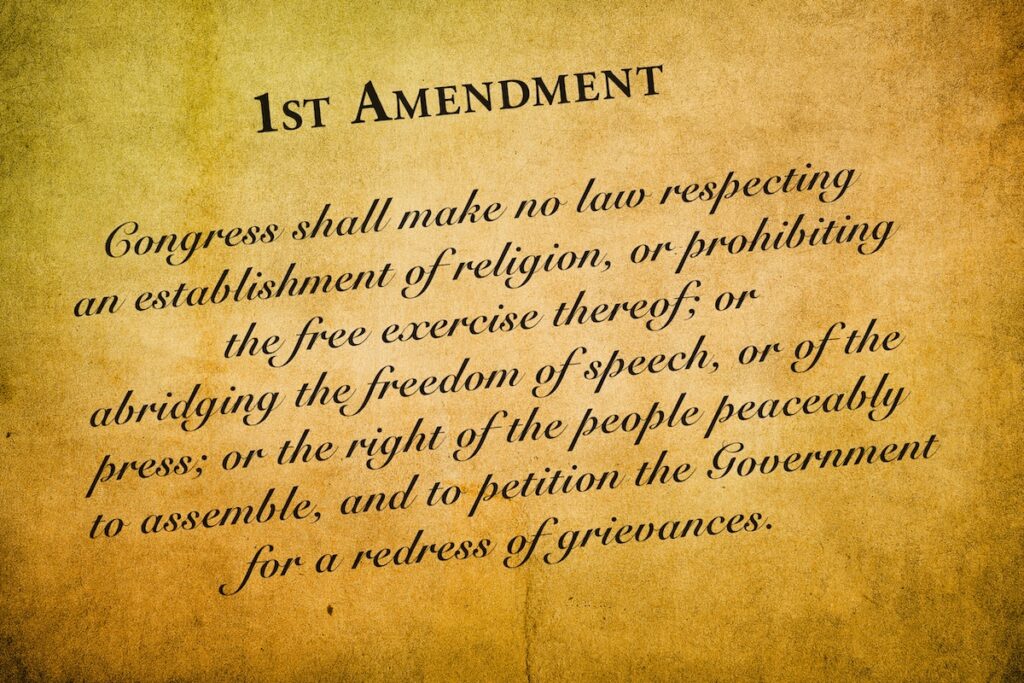
SourcesSource A: First Amendment, Bill of Rights
Source B: Excerpt from a summary of "Tinker v. Des Moines School District"
Source C: Excerpt from a summary of Bethel School District v. Fraser
2
Supporting QuestionDoes the “no prior restraint” rule apply to students?
Formative TasksExplain in a paragraph the extent to which the Constitution’s no prior restraint rule applies to the Hazelwood and Layshock cases.
SourcesSource A: Definition of the term “prior restraint”
Source B: A summary of "Hazelwood School District v. Kuhlmeier"
Source C: Excerpt from a summary of "Layshock v. Hermitage School District"
3
Supporting QuestionHow does the Supreme Court determine the limits of students’ rights?
Formative TasksWrite a concurring or a dissenting opinion on Morse v. Frederick.
SourcesSource A: A summary of Morse v. Frederick
Source B: Excerpt from Justice Thomas’s concurring opinion in Morse v. Frederick
4
Supporting QuestionCan school officials exert control over students’ use of social media?
Formative TasksDevelop a claim supported by evidence about school control over social media that answers the supporting question.
SourcesSource A: Excerpt from Judge Kravitz’s Memorandum of Decision in "Doninger v. Niehoff"
Source B: Excerpt from Judge Garber’s decision in "Evans v. Bayer"
Source C: Excerpt from Judge Simon’s decision in "T. V. v. Smith-Green Community School Corporation"
Source D: Excerpt from Judge Wilson’s decision in "J. C. v. Beverly Hills United School District"
Summative Performance Task
Argument: Are students protected by the First Amendment? Construct an argument (e.g., detailed outline, poster, essay) that addresses the compelling question using specific claims and relevant evidence from historical and contemporary sources while acknowledging competing views.
Extension: Have an informed debate in class about whether students are protected by the First Amendment.
Taking Informed Action
Understand: Investigate the challenges to New York students’ First Amendment rights in the digital age by researching cases of cyberbullying and legislation aimed at protecting students.
Assess: Evaluate the school’s current cyberbullying and social media policies and the extent to which they align with recent First Amendment legislation.
Act: Evaluate the school’s current cyberbullying and social media policies and the extent to which they align with recent First Amendment legislation.